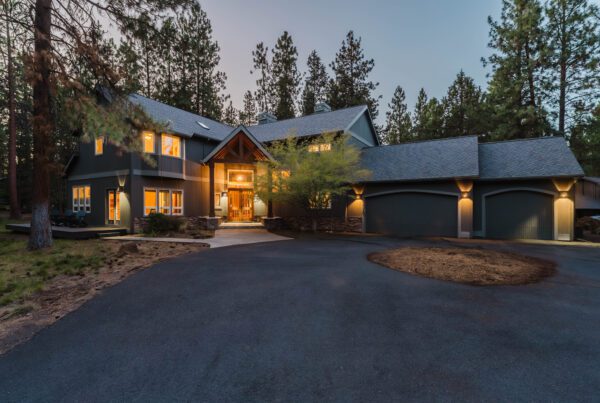

To check outdoor lighting in Bend, identify the parcel first. The city and unincorporated Deschutes County have separate codes. Once you know which one applies, check the installed fixture, its aim and its controls. A bulb package alone cannot answer those questions.
How can I check the lights on a house I already own?
Choose one fixture that causes a specific problem. A floodlight over the garage might light the neighbor’s bedroom while leaving your steps hard to see. Stand where the glare is visible, then walk the route the light is supposed to serve. Record both observations.
Make a four-line note: location, fixture model, direction and control. Compare that note with the public code for the parcel. If you need a replacement, give the product sheet and installation details to the planning office or your installer. A different aim, shield or mounting height may change the result even if the bulb stays the same.
Start with the property’s jurisdiction
Check the parcel in Deschutes County DIAL and confirm whether it is inside Bend’s city limits. A “Bend, OR” postal address can still be outside the City. If the home is in a planned community, also review the HOA or architectural rules; private restrictions can be more specific than the public code.
This distinction matters because some rules often described as “Bend dark-sky rules” actually come from Deschutes County Code Chapter 15.10, which took effect December 23, 2025, rather than from the City’s development code.
What the City of Bend code requires
Bend Development Code 3.5.200 applies to outdoor lighting used for buildings, recreation areas, parking and maneuvering areas, landscaping, streets and signs, display areas, canopies, holiday celebrations and construction.
For new fixtures installed after February 18, 2004, the City’s core rule is functional: use a full-cutoff fixture or another shielding method that directs light down onto the site without direct illumination or glare on adjacent property. In the City code, a full-cutoff fixture projects no light above its horizontal plane.
The same section contains important qualifications:
- Lawfully installed fixtures operating before the section’s effective date are generally exempt until they are replaced, although re-aiming or adding shielding is encouraged when light reaches beyond the property.
- Residential decorative and low-wattage yard or driveway lighting can be exempt when it does not create glare, direct illumination or a cast shadow on adjacent property.
- Contained uplighting can qualify for an exemption when an architectural or landscaping element keeps the light on its intended target and out of the night sky.
- Low-wattage holiday lighting is exempt for no more than 60 days.
The current City section does not create a universal residential 3,000-Kelvin limit or an 11 p.m. deadline for string lights. Do not apply the County’s rules to a City property without checking the controlling code.
What changes in unincorporated Deschutes County
The County chapter requires nonexempt outdoor lighting to be downcast, fully shielded and arranged to prevent direct illumination beyond the property line. Its definitions and exemptions are more detailed than the City’s in several areas.
- Existing fixtures: The County’s nonconformance section gives lawfully installed older fixtures a temporary exemption and states that the exemption ends three years after adoption. Because the chapter became effective December 23, 2025, confirm the exact deadline and any property-specific exception with Deschutes County before planning a retrofit.
- Residential string lights: They may outline patios, porches, decks and similar structures, may not flash or flicker, and must be off by 11 p.m. Holiday lights follow a separate exemption.
- Holiday and event lighting: Seasonal holiday lighting from the day after Thanksgiving through January 15 is exempt. Other event-specific lighting has its own limited duration.
- Color temperature: The County chapter encourages warm-colored light as a guiding principle, but it expressly says those guiding principles are not mandatory approval criteria. Do not turn that recommendation into a blanket 3,000-Kelvin legal requirement.
Make a fixture list before shopping
Walk the property after dark and record every outdoor fixture you can control. For each one, note its purpose, whether you can see the bulb from the street or a neighboring window, where the beam lands and how long it stays on. Start with the fixtures that send light beyond the intended area.
Use photos and product sheets to compare possible fixes. Ask the supplier or electrician how the fixture will aim once mounted, how its controls work, and whether the housing shields the light source from the side. Take the property address and fixture details to the applicable permitting office if you need a code answer.
Audit the actual fixtures, not the marketing label
“Dark-sky friendly,” “warm” or “motion activated” on a package does not by itself establish compliance. For each exterior fixture, record:
- where it is mounted and what area it is intended to illuminate;
- whether the source is visible from the side or above;
- whether a shield directs the beam below the horizontal plane;
- whether direct light reaches a neighboring lot, window or public right-of-way;
- whether the fixture is permanent, portable, decorative, seasonal or part of a sign;
- whether it predates the applicable rule or is being replaced; and
- what timers, motion sensors or dimmers control its operation.
Then compare the fixture with the code that applies to the parcel. A bulb change is not always treated the same as replacing a fixture or housing. When wiring, mounting, permitting or code interpretation is uncertain, ask the applicable planning or code-enforcement office and use a qualified electrical contractor.
What buyers and sellers should verify
Buyers should include exterior lighting in the property walk-through and due-diligence plan, especially on rural acreage, homes with extensive landscape lighting, sports areas, long driveways or neighboring bedrooms close to the property line. Note fixture locations after dark when practical, review HOA documents and request permits or contractor records for substantial recent work. Our home-inspection guide for buyers explains how to separate a general inspection from specialist follow-up.
Sellers can reduce avoidable questions by identifying jurisdiction, re-aiming obvious glare, replacing failed components safely and keeping product or contractor records. Do not promise that a fixture is compliant based only on its age, appearance or packaging.
Questions and answers about dark-sky lighting in Bend
Which outdoor fixture should I change first?
Start with the bulb or bright surface you see from a neighbor’s window, the sidewalk or the driveway. Have someone stand at the entry while you test the switch. If shielding one fixture lights the step and removes the direct view of the bulb, you have a concrete improvement to evaluate before replacing the others.
What does “dark-sky compliant lighting” on a box tell me?
Read the specification sheet before buying. Note the model, light output and where the fixture directs the light. Compare those details with the rules for the property and any HOA approval you need. A label alone cannot tell you how the light will land once it is mounted.
Does a motion sensor solve a glare problem?
A sensor changes when a light comes on. It does little for a visitor who sees a bare, bright bulb when it does. Test the aim and shield first. Then walk the path to see whether the sensor turns the light on when someone actually needs it.
What should I keep after the work?
Save the fixture’s model sheet, a night photo taken from the neighboring side and any written HOA approval. If a buyer asks about the change, those records are more useful than the words “dark sky” on the sales box.
A practical decision rule
Use the least light necessary for the task, direct it only where needed and control when it operates. That approach fits the purpose of both the City and County codes, but legal compliance still depends on the parcel, fixture, installation date, use and applicable exemptions.
Codes can change, and this guide cannot decide a specific enforcement or electrical question. If you are evaluating a Bend-area home, start with Bend Relo’s buyer resources or contact Bend Relo. We can help organize the property-specific questions while the appropriate public office, inspector and licensed contractor address issues within their expertise.
Talk with David & the Bend Relo team
Buying, selling, relocating, or evaluating a specific property? Tell us what you are working through. We are happy to help.